How to Gain Weight With a Fast Metabolism
You eat a lot. Or at least you think you do.
You had a big lunch yesterday. You snacked all afternoon. You finished dinner and felt full. And yet the scale hasn't moved in months. Maybe years.
Here's the uncomfortable truth most "how to gain weight" articles won't tell you directly: you're probably eating less than you think. Not because you're lying to yourself, but because human beings are genuinely terrible at estimating calorie intake. A study published in the New England Journal of Medicine found that subjects underreported their actual food intake by an average of 47%. That's not a rounding error. That's nearly half your calories going unaccounted for.
Having a fast metabolism is real, but the difference is smaller than most people assume. According to research reviewed by Examine, 96% of the population falls within a range of 200 to 300 calories of each other in resting metabolic rate. Assuming an average expenditure of 2,000 calories per day, 96% of people have a resting metabolic rate between 1,680 and 2,320 calories daily. That's a meaningful gap at the extremes, but not the 1,000-calorie difference many hardgainers imagine.
The real issue isn't your metabolism. It's your system for eating enough, consistently.
Why Generic Advice Fails Hardgainers
Every weight gain article on the internet says the same thing: eat more calories. Eat nuts. Drink whole milk. Eat six meals a day.
That advice isn't wrong. It's just useless for someone whose appetite is already maxed out at three meals. Telling a hardgainer to "just eat more" is like telling someone with insomnia to "just sleep more." The intent is fine. The execution is where everything breaks down.
The real problem is that hardgainers need a system, not more willpower. Willpower runs out around 2pm when you're staring at meal four and your body is telling you it doesn't want food. A system doesn't care how you feel. It tells you what to do next.
Here's what that system looks like.
Step 1: Find Your Actual Number
Before you change anything about your diet, you need to know your baseline. Specifically, your Total Daily Energy Expenditure (TDEE), which is the total number of calories your body burns in a day including activity.
You can estimate this using the Harris-Benedict formula for your Basal Metabolic Rate (BMR), then multiplying by an activity factor. For males, the BMR formula is: 66 + (13.7 x weight in kg) + (5 x height in cm) - (6.8 x age in years). For females: 655 + (9.6 x weight in kg) + (1.8 x height in cm) - (4.7 x age in years).
From there, multiply by your activity level. Healthline recommends these multipliers: 1.2 for sedentary, 1.375 for lightly active (one to three days per week), and higher for more active lifestyles.
Once you have your TDEE estimate, add 300 to 500 calories on top. That's your daily target. If you want to gain weight faster, Healthline suggests aiming for 700 to 1,000 calories above your maintenance level, though a slower approach of 300 to 500 extra calories per day leads to steadier, more sustainable gains.
Write this number down. It's the single most important thing in your weight gain plan.
Step 2: Eat Calorie-Dense Foods (Not More Food)
The mistake most hardgainers make is trying to eat more volume. More chicken breast. More rice. More broccoli. This fills your stomach before you've hit your calorie target.
The fix is eating foods that pack more calories into less space. Healthline lists several energy-dense options for weight gain:
- Nuts and nut butters: almonds, walnuts, peanut butter. A hundred grams of almonds contains roughly 50 grams of fat, making them one of the most calorie-dense snacks available.
- Dried fruit: raisins, dates, prunes. Easy to eat, no prep required.
- High-fat dairy: whole milk, full-fat yogurt, cheese.
- Healthy oils: extra virgin olive oil and avocado oil. Drizzle olive oil on rice, pasta, vegetables, basically everything. Each tablespoon adds around 120 calories without making you feel full.
- Trail mix: a combination of nuts, seeds, and dried fruit that travels well and requires zero preparation.
The goal isn't to force-feed yourself. It's to choose foods where a small handful or a drizzle adds hundreds of calories without filling you up.
Step 3: Drink Your Calories
This is the single most underrated trick for hardgainers. When your appetite is low, drinking calories is dramatically easier than eating them.
A weight gainer shake with whole milk, a banana, two tablespoons of peanut butter, and a scoop of protein powder can easily clear 600 to 800 calories in a glass. You can drink it between meals without killing your appetite for actual food.
Healthline specifically recommends weight gainer shakes for people who have trouble gaining weight. Whole milk on its own is also effective. One glass has about 150 calories and a solid mix of protein, carbs, and fat.
Liquid calories bypass the "I'm full" signal that solid food triggers. If you're struggling to eat enough, start here.
Step 4: Eat on a Schedule, Not by Hunger
Hardgainers can't trust their hunger signals. If you only eat when you're hungry, you'll under-eat every single day. That's the whole problem.
Instead, set fixed meal times and eat whether you feel like it or not. Three meals plus two to three snacks is a common framework, but the specific timing matters less than the consistency. Some people do better front-loading calories with a big breakfast when morning appetite is higher. Others prefer to back-load, eating lighter during the day and having their biggest meal at dinner.
Figure out when your appetite is strongest and stack your biggest meals there. Fill the gaps with calorie-dense snacks and shakes.
Step 5: Add Strength Training
If you're gaining weight without resistance training, a significant portion of that weight will be fat. Strength training signals your body to build muscle, which means more of your caloric surplus goes toward lean mass.
Beyond directing where the weight goes, resistance training also tends to increase appetite. Examine's research review found that the process of building skeletal muscle (hypertrophy) has a high caloric cost. That increased energy demand often translates to increased hunger, which is exactly what a hardgainer needs.
You don't need a complicated program. Compound movements like squats, deadlifts, bench press, and rows, done three to four times per week, are enough to stimulate growth. The goal is progressive overload: gradually increasing the weight or reps over time.
Step 6: Track Without the Friction
Here's where most hardgainer plans fall apart. You know the numbers. You know the foods. You even know the schedule. But within a week, you stop tracking because the process of logging every meal feels like a second job.
Traditional calorie tracking apps require you to search databases, scan barcodes, or weigh portions for every single item. When you're already forcing yourself to eat more than feels comfortable, adding fifteen minutes of data entry per meal is the last thing you want.
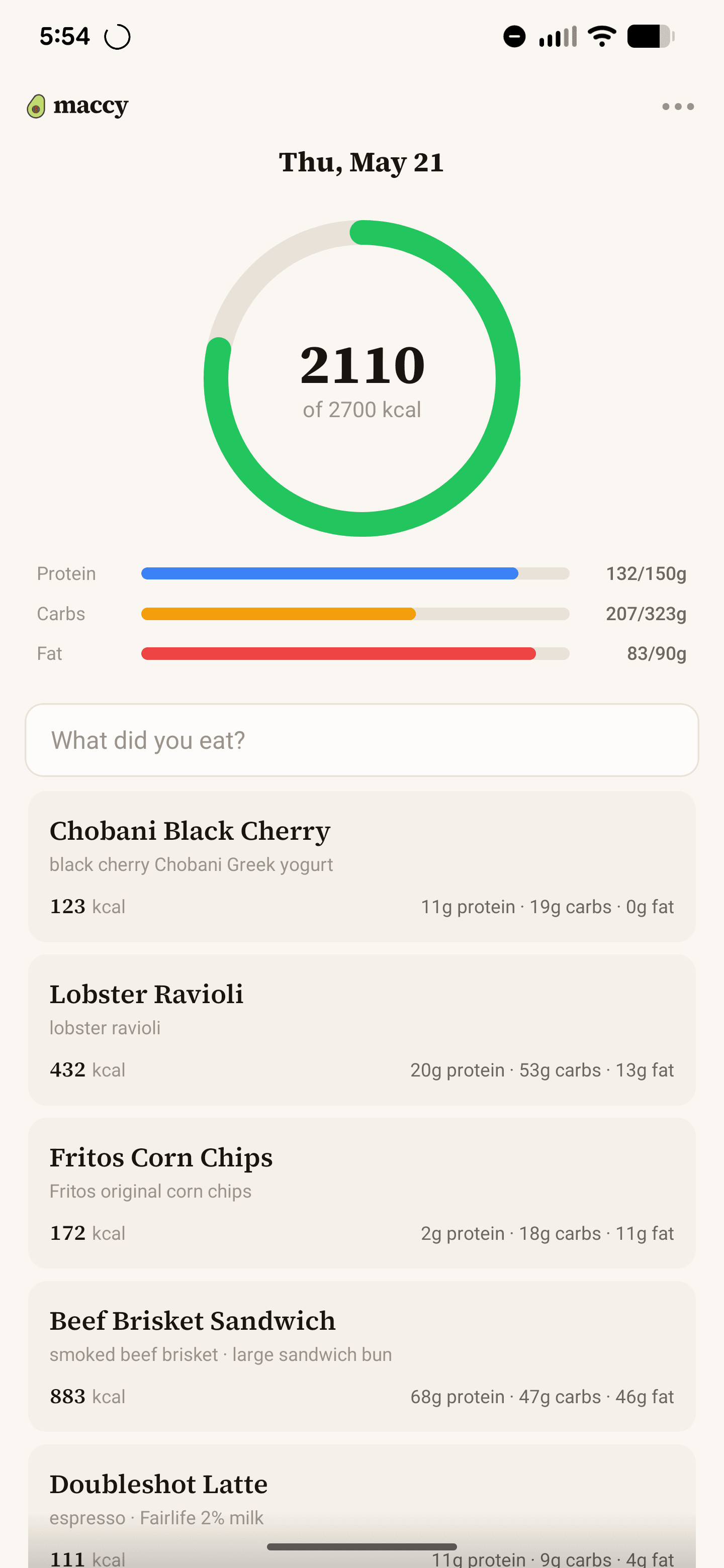
This is the problem Maccy was built to solve. Instead of searching or scanning, you type what you ate in plain language. Something like "bowl of rice with chicken thigh and teriyaki sauce" and it logs the calories and macros using USDA nutrition data. You can even batch-log your entire day at night in a couple of minutes.
Where apps like MyFitnessPal require you to search a database, take a photo, or scan a barcode for every food you log, Maccy lets you type what you ate in plain language and handles the rest. No weighing. No scanning. No searching through endless database entries.
The reason this matters for hardgainers specifically: tracking is the difference between thinking you're eating enough and knowing you're eating enough. Remember that study about people underreporting intake by 47%? The gap works both ways. Hardgainers who think they're eating 3,000 calories are often closer to 2,200. Tracking reveals the gap. But only if the tracking itself is sustainable.
If you've tried calorie tracking before and quit, it probably wasn't because you lacked discipline. It was because the tool added too much friction to a process that was already hard. You can explore alternatives to traditional trackers to find something that actually fits your workflow.
What About Supplements?
A few supplements are worth considering. Healthline mentions creatine monohydrate as a supplement that can help with muscle weight gain, which makes it useful alongside a strength training program. Protein powder (whey protein specifically) is practical if you're struggling to hit your protein targets through food alone. The FDA recommends adults eat 50 grams of protein daily, though most people trying to gain weight will want significantly more than that baseline.
Beyond creatine and protein powder, most weight gain supplements are overpriced calories you could get cheaper from food. Prioritize real food first.
The Plan, Summarized
- Calculate your TDEE and add 300 to 500 calories. That's your daily target.
- Build meals around calorie-dense foods: nuts, nut butters, oils, whole milk, dried fruit.
- Drink a calorie-dense shake once or twice daily to fill gaps.
- Eat on a fixed schedule. Don't wait for hunger.
- Lift weights three to four times per week to direct weight toward muscle.
- Track your intake with a tool that doesn't make you hate the process.
The hardest part of gaining weight with a fast metabolism isn't the eating. It's knowing whether you're actually eating enough. Get that visibility, stay consistent for eight to twelve weeks, and the scale will move.
Read more
Guide
Easiest Way to Track Macros
Tired of the effort you spend logging? Here are the easiest ways to track macros, from food journals to plain-language apps that do the work for you.
Guide
How to Count Macros: A Practical Guide
Learn how to count macros without spreadsheets or food scales. A step-by-step guide to calculating protein, carbs, and fat targets and actually sticking with it.
Explainer
Does Eating Fat Make You Fat? Macro Mythbusting
Does eating fat make you fat? No. Calories control weight gain, not fat itself. Learn which fats to eat, how much you need, and how to track your fat intake.